


The art of faceting
Cutting is where a rough crystal becomes a gem. It's also two almost entirely separate crafts, one for diamond, one for everything else, that have evolved on different paths for centuries. This is the long story of both.
Mining finds the crystal. Cutting reveals the gem.
A rough stone out of the ground is rarely beautiful. Almost everything we recognise in a finished gem, its brightness, its fire, the depth of its colour, is created at the cutting bench, by the angles and proportions a cutter chooses. Cutting is the single step that most decides whether a stone sings or stays dull.
What's less widely understood is that diamond cutting and coloured-stone cutting are not really the same trade. They use different tools, different logic, and different cutters, one craft industrial and automated, the other still largely done by hand. This page follows both: how their cuts evolved, the tools behind them, and why some stones are best left barely touched.
One material, or a thousand
A diamond is always the same material, with the same optical properties, however it's mined. That single fact lets the whole craft converge on one answer: there is a mathematically best way to cut a round diamond, and the industry has spent a century chasing it. Diamond cutting became a science.
Coloured stones are the opposite. Sapphire, emerald, tourmaline, garnet and hundreds of others each bend light differently, vary in hardness, and often carry colour unevenly through the crystal. There is no single ideal, the cutter has to read each individual stone and decide how to bring out its colour while keeping as much of it as possible. Coloured-stone cutting stayed an art.


Light, angles, and the critical angle
Most faceted gems have a flat top table, a crown of facets above the girdle, and a pavilion of facets below it. Light enters through the crown, bounces off the pavilion facets, and returns to your eye. Get the angles right and almost all of it comes back as brightness and fire; get them wrong and it leaks out the bottom, leaving a dull 'window'.
The angle that matters most depends on how strongly the material bends light, its refractive index. Diamond bends light so strongly that its best angles are fixed and well known. Every coloured species has its own, which is why a sapphire and an emerald can't be cut to the same recipe, and why a good coloured-stone cutter is, in effect, solving a different problem with every stone.
Two lineages, side by side
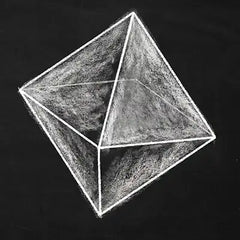
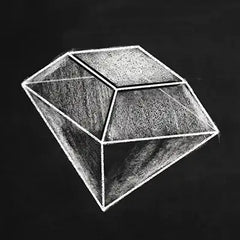
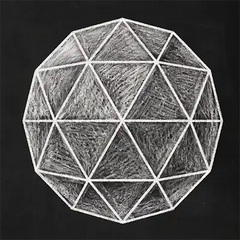
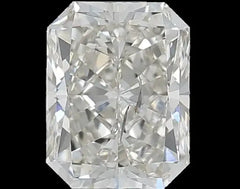
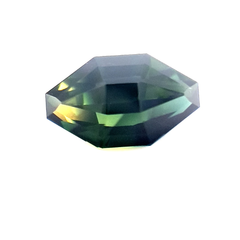
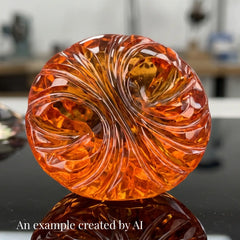
Both crafts began the same way, by polishing the faces a crystal already had, and then diverged. Read these as parallel illustrated timelines: the diamond cuts on one side, the coloured-stone styles on the other. (Add a photo to each milestone.)
Diamond


Coloured stone



The bench, before the machines
Every leap in cutting style was really a leap in tooling. For diamond, this 18th-century engraving captures almost the whole hand-cutting world in one frame; coloured stone kept its own, simpler tools alongside it. Here's how the craft was done before lasers.

“Diamond Cutters Wheel or Mill”, an 18th-century engraving showing cutters at scaifs often powered by water wheels, the diamond held to each spinning lap by a clamp (the dop, or tang). The tools are laid out at lower right.
From a cutter's eye to a robot's
Over the last few decades diamond cutting has been transformed from a hand craft into a high-technology pipeline. A modern stone is scanned, planned by software, sawn by laser and increasingly polished by machine, with people stepping in mainly for the largest and most valuable stones. (Add pipeline cards as blocks below.)
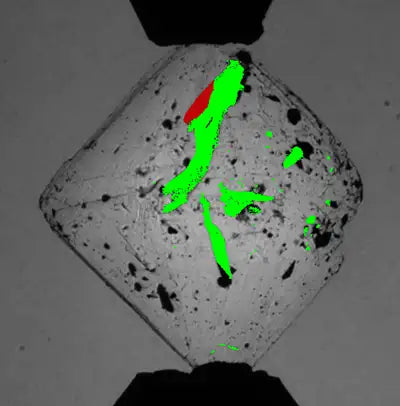
Scan & map
The rough is 3D-scanned and its inclusions mapped automatically. Planning software, pioneered by Sarine from the mid-1990s, models every stone that could be cut from it and picks the most valuable plan.
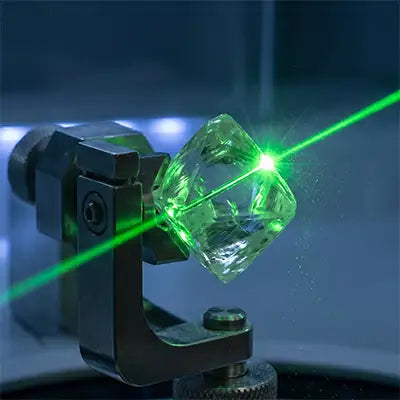
Laser sawing
Green-laser saws split the rough exactly along the planned lines, far faster and more precise than old diamond-blade saws. Some laser systems can now cut all the facets of a round in a single automated pass.
Automated & robotic polishing
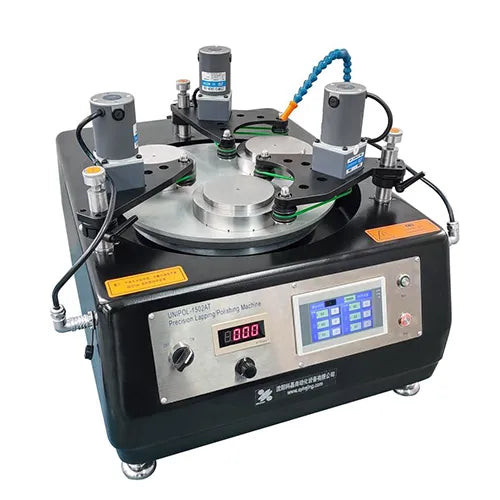
Robotic systems align, band and saw dozens of stones at once, guided by each stone's plan and refined by AI. Much of the world's small diamonds are now cut with very little human touch.
The human hand
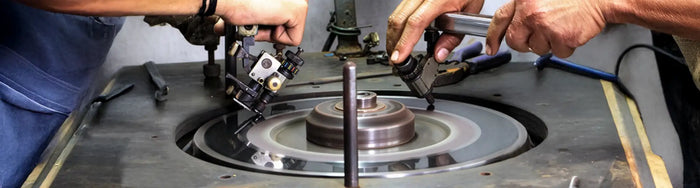
The largest, rarest and fancy-shaped diamonds still go to master cutters in Antwerp, Israel and New York, where a single wrong angle can cost a fortune, judgement no machine is trusted with yet.
Precision cut, or traditional cut?
Among coloured stones especially, the biggest difference between two gems is often the philosophy behind the cut. The two approaches lead to genuinely different stones, and the right one depends on the gem and on what you value in it.
Cut to highly controlled proportions and symmetry, with the goal of maximum light performance, usually on modern faceting machines that hit each angle exactly. Bright, even and lively face-up. It often means giving up a little weight to get the optics right. Most sapphire cut in Australia, including ours, is precision cut.
Cut in the traditional way, following the rough to preserve the natural colour, character and weight of the crystal, rather than chasing strict calibration. Common to much origin-country cutting, and a deliberate, skilled choice: a well-judged traditional cut keeps colour and individuality a calibrated stone would lose. (Not to be confused with antique cuts like the Old European.)
Saying what we actually mean
Describing a cut well means separating three different questions that the trade has too often bundled into one word. We keep them apart on purpose.
A note on language: gemstones cut to preserve the natural shape, colour and weight of the rough have often been called "native cuts" in the trade. We've chosen to retire that term. It bundles together where a stone was cut, how it was cut and how good the result is, three unrelated things, and it has drifted into a catch-all for "crude," which is both unfair and frequently wrong. Instead we say traditional cut for the approach, name the country for the origin, and name any fault plainly. One loaded label, replaced by clear ones, and, we hope, a small push toward better language across our industry.
The cabochon, and the star
Long before anyone cut a facet, gems were shaped as cabochons, smooth, domed, polished forms with no facets at all. It's the oldest way to finish a stone, and for thousands of years it was the only one. A cabochon shows off colour and texture rather than sparkle, and it remains the right choice for opaque or heavily included material, and for stones with a secret to reveal.
That secret is phenomena. Cut as a cabochon, a sapphire with the right aligned silk inclusions throws a sharp six-ray star, asterism, that no faceted stone can show; the same trick gives us cat's-eye and moonstone's glow. The Black Star of Queensland is the most famous example there is. Cabochons also had a great design moment in the Art Deco era, when bold, smooth cabochon sapphires, emeralds and rubies were set against geometric diamond mounts for colour and contrast.
And they're back. There's a real, current revival of interest in the cabochon, partly as a reaction to a world of identical faceted stones, partly because the soft, glowing look simply suits modern taste. We're seeing it most in sapphire and tourmaline, where a fine cabochon can hold colour and depth in a way a faceted stone never quite does.


The stones we choose not to cut
Not every stone should be cut. Sometimes the most skilled decision a cutter or miner makes is to leave one alone, because the rough is already beautiful, or because cutting would destroy something cutting can't replace.
A sapphire that has tumbled through a river system for millions of years can emerge waterworn, its surface frosted and sculpted, its form smoothed into something a machine would never produce. Set as it is, that texture and history are the whole point. A rough diamond, too, can arrive as a near-perfect octahedron, a natural eight-sided crystal of such clean geometry that faceting it would only subtract. Both are increasingly prized exactly as the earth delivered them.
There's a quieter reason, as well. An uncut stone is honest about what it is and where it came from, no facets to flatter it, nothing hidden. For a buyer who values provenance over polish, a fine piece of rough can say more than a finished gem.
The cutting capitals
Cutting has always clustered in a handful of cities, first near the stones or the trade routes, now wherever skill and cost line up. The two crafts have largely separate maps. (Add centres as blocks below.)
Diamond
Coloured stone
Cut by people we know
We've watched our Australian sapphire take shape at the bench, and seen our diamond cutters at work through the footage they send from India. We're drawn to the part of this story the machines can't reach, the cutter who reads a single stone and decides how best to set its colour free.
For coloured stones and characterful diamonds especially, the cut is where character is made or lost. A clean white diamond can follow proven proportions, but a sapphire, or a salt-and-pepper diamond, has to be read on its own terms. Knowing who cut a stone, and how, and whether it was right to cut it at all, is part of how we choose the ones we offer.
A clean white diamond can follow the numbers. A sapphire, or a salt-and-pepper diamond, has to be understood.

The step that makes the gem
Mining and luck produce the crystal. But the cut, the angles, the patience, the judgement, and sometimes the decision not to cut at all, is what turns it into something worth wearing. It's the least visible part of a gem's story, and arguably the most decisive.
Whether it's a diamond shaped by laser to a hundredth of a degree, a sapphire read by hand at a bench, or a waterworn crystal left exactly as it was found, the goal is the same: to let the most light, and the truest colour, find their way to your eye.
See how the cut shows in our stones, or talk to us about a bespoke cut.
Explore our gemstones